Suwon Lumbar Disc and Spinal Stenosis: Assessment and Selective SART, Acupotomy and Bee-Venom Care
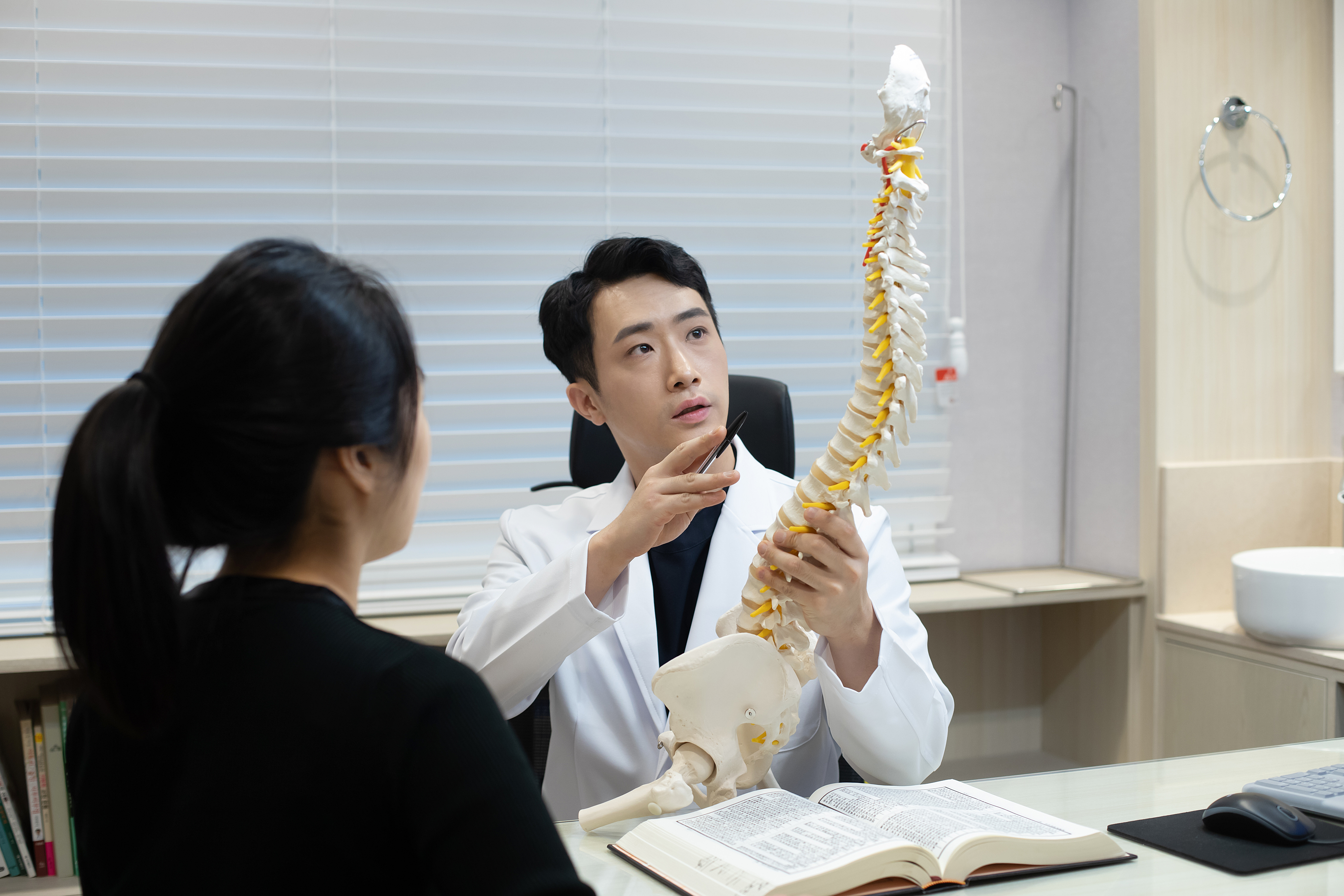
Low-back pain, leg numbness or shorter walking distance: what should be checked first?
Lumbar disc herniation and spinal stenosis can both cause leg pain or numbness, but symptoms alone do not distinguish them. Bodyall reviews the history, neurological status, gait, and spinal and pelvic movement before deciding whether Chuna care is suitable. Weakness or a new bowel or bladder change takes priority over routine correction consultation.
| Option to discuss | What Bodyall checks | Important limit or risk |
|---|---|---|
| SART | Site, direction and intensity based on symptoms, range of motion and gait | Linked with movement guidance and reassessment; it does not guarantee disc restoration or widening of the spinal canal. |
| Acupotomy | Need, treatment site, medicines and individual risk factors | An invasive procedure with risks including bleeding, infection and injury to nerves or nearby tissue. |
| Bee-venom pharmacopuncture | Allergy history and individual suitability | Requires separate risk discussion because systemic hypersensitivity and anaphylaxis can occur. |
There is no fixed sequence requiring all three treatments. Bodyall decides on each option and the need for medical testing or referral after examination.
Reason to choose Bodyall: leg numbness and walking limits are not treated as a low-back-only complaint. Neurological findings, gait, and spinal-pelvic movement are assessed together. When conservative care is appropriate, the clinician selects myofascial Chuna or a SART approach that may include spinal or pelvic correction, while the need and risks of acupotomy and bee-venom pharmacopuncture are judged separately. Walking distance, sitting, standing and the original difficult movement are then reassessed. This gives Suwon patients a clear reason to choose Bodyall when they want differential assessment and functional follow-up in one care pathway.
Seek urgent care for newly impaired urination or bowel control, numbness around the saddle area, rapidly worsening leg weakness or sudden difficulty walking. Severe back pain with fever, pain after major trauma, or new pain with a cancer history also needs prompt medical assessment.[3][4][5]
1. Can pelvic torsion alone explain disc herniation or stenosis?
No. Lumbar disc herniation involves disc tissue protruding through the outer annulus and may irritate a nerve root. Stenosis describes narrowing around neural structures from degenerative changes in bone, joints or ligaments. Age, trauma and repeated loading can contribute, so Bodyall does not determine the cause from pelvic shape or posture alone.[3][4]
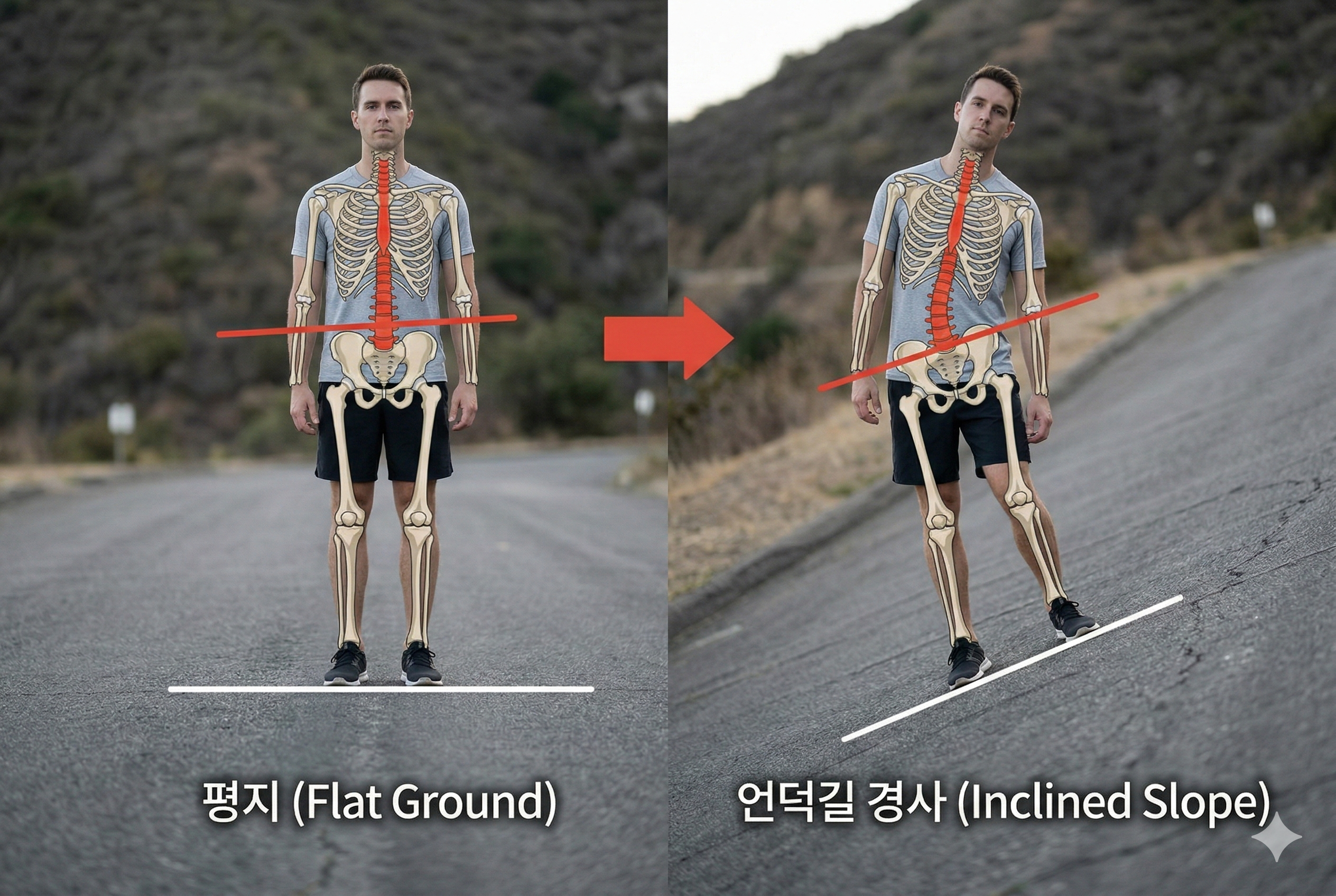
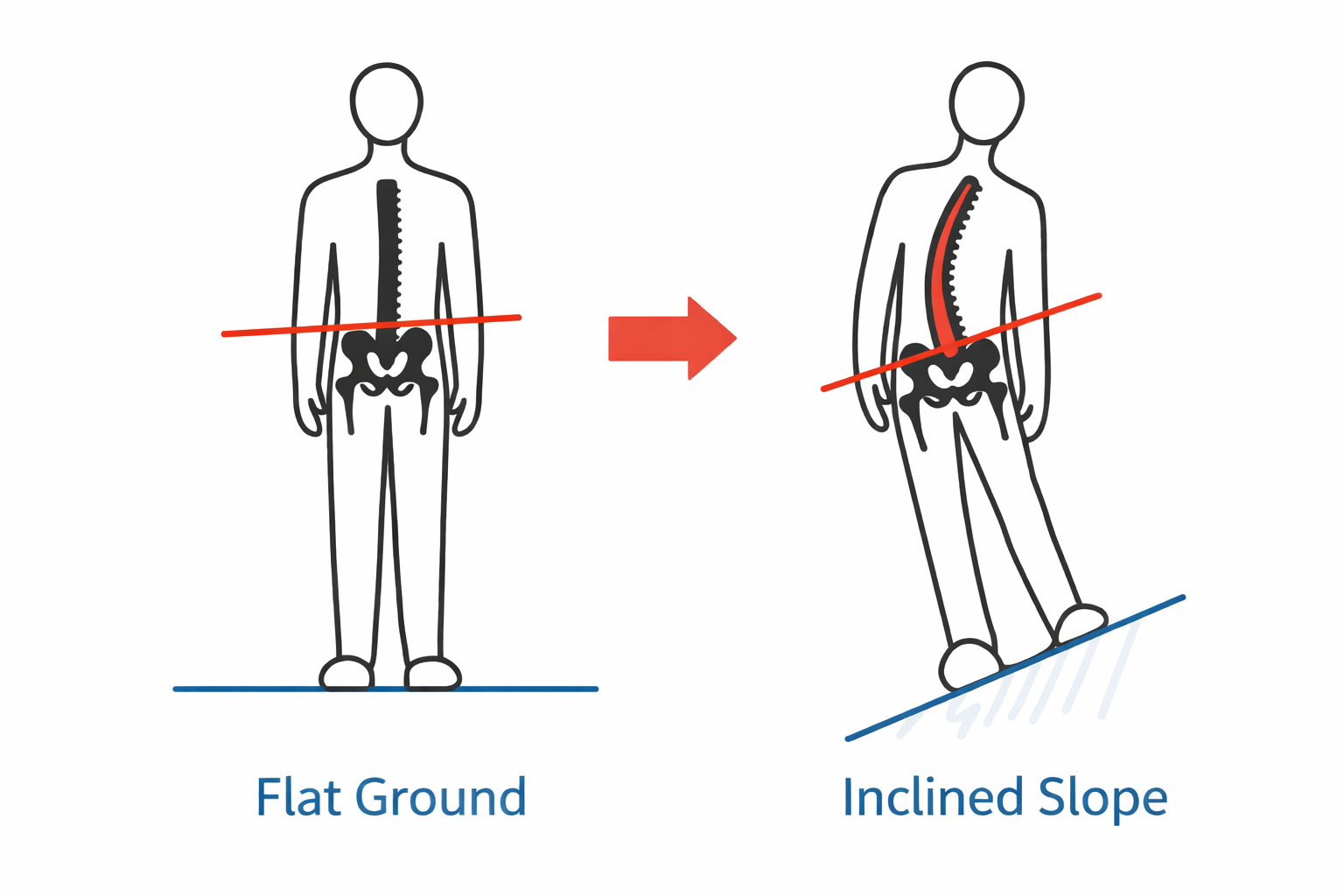
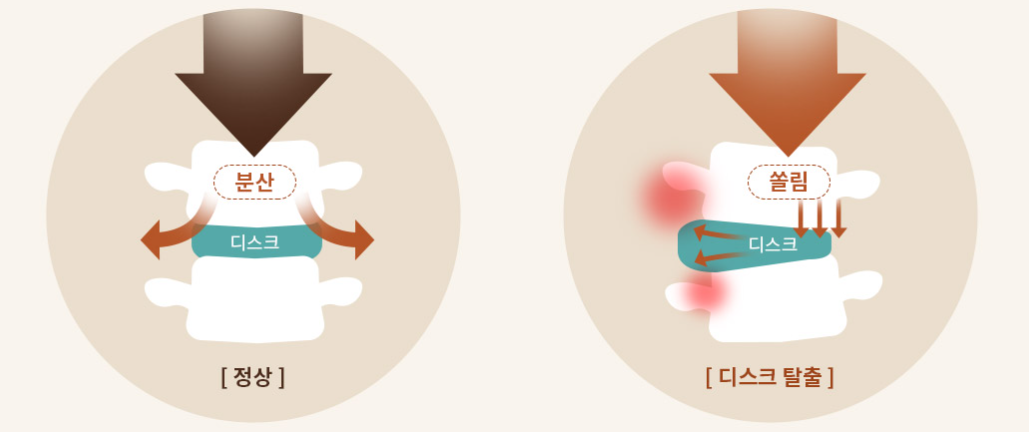
These images explain mechanical concepts. They are not patient diagnostic scans or proof that correction removed nerve compression.
- Load and movement: identifying whether bending, lifting, twisting, sitting, standing or walking aggravates symptoms helps guide daily movement.
- Diagnosis: posture and palpation are parts of the examination; disc or nerve involvement requires symptom, neurological and, when needed, imaging correlation.
2. What movement and daily limitations does Bodyall examine?
Bodyall's SART consultation begins with symptoms and history, spinal and pelvic palpation, active and passive range of motion, gait and posture. Tell the clinician which of prolonged sitting, standing, walking, bending or extension is limited.
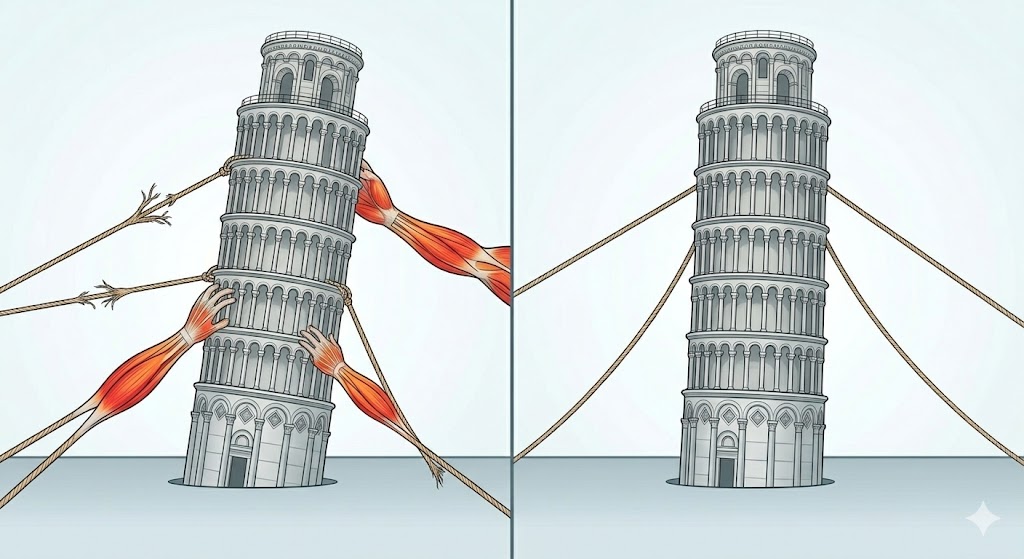
- Muscle tension: stiffness alone does not prove bony malalignment or deep adhesion; pain avoidance and other regional problems must also be considered.
- Before-and-after comparison: location and intensity of pain, range of motion, gait and daily tasks are compared. Temporary relief is distinguished from sustained functional change.
3. Lumbar disc herniation and spinal stenosis are not the same
| Feature | Lumbar disc herniation | Lumbar spinal stenosis |
|---|---|---|
| Relevant structure | Disc protrusion or herniation with possible nerve irritation | Narrowing of the canal or neural passage |
| Symptoms to discuss | Back-to-leg pain, numbness, sensory or strength change | Leg pain or numbness with standing or walking, sometimes eased by sitting or bending |
| Interpretation limit | Not all low-back pain is disc-related. | Posture-dependent symptoms alone do not confirm stenosis. |
| Treatment decision | Severity, neurological findings, functional limitation and course determine conservative care and the need for specialist assessment. | |
These are common patterns with exceptions. Imaging and specialist review are used when needed; not every episode of low-back pain requires immediate MRI.[3][4][5]
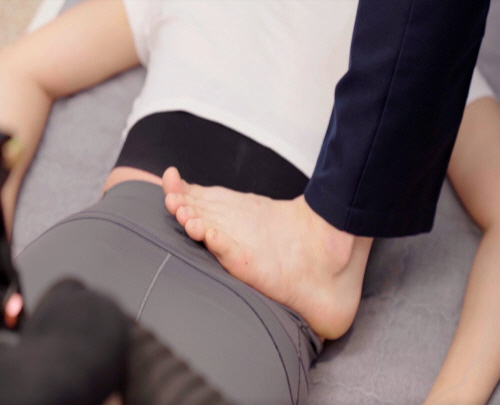
4. How are SART, acupotomy and bee-venom pharmacopuncture selected?
A 2023 pilot randomized trial assigned 34 patients with lumbar spinal stenosis to two groups and compared eight weeks of acupuncture and interferential-current treatment with or without additional acupotomy. Both groups improved on some pain and function measures, but the study did not identify significant between-group differences in key group-by-time analyses. With a small sample and follow-up to 12 weeks, it cannot establish additional benefit or long-term safety.[1]
SART suitability consultationAt Bodyall, SART is explained as a Chuna process connecting selected spinal or pelvic correction, active-movement reassessment and daily-movement guidance. Direction and intensity are adjusted to the patient's condition.
This process does not mean that a herniated disc is restored on MRI or that a narrowed canal is permanently enlarged. General manual-therapy guidance does not directly prove a particular SART effect. Worsening symptoms, weakness and fracture risk are checked first, and application can be deferred.
Acupotomy suitability and riskAcupotomy uses a bladed needle and is invasive. Bodyall evaluates the site and depth, medicines, bleeding risk and infection before discussing whether it is needed. It is not a mandatory addition to SART.
A 2025 systematic review and meta-analysis addressed acupotomy for lumbar spinal stenosis.[2] This page cites its topic and design only, without transferring its results to Bodyall's outcomes, a combined SART effect, or all lumbar disc patients.
Bee-venom allergy-risk consultationLocal and systemic hypersensitivity, including anaphylaxis, can occur. A previous uneventful injection or skin test does not guarantee safety; suitability is judged separately.
Persistent bleeding, fever, swelling, or new sensory or strength changes after acupotomy need prompt care. Shortness of breath, throat swelling or faintness after bee-venom treatment requires emergency help.[6]
5. When should exercise, medication, injection or surgery be discussed?
Without emergency warning signs, appropriate activity adjustment, exercise, medication and rehabilitation can be considered. Prolonged complete rest is usually not the goal. Medicines need to be selected with gastrointestinal, kidney and cardiovascular risks and other medicines in mind.[3][5]
NICE recommends considering manual therapy only as part of a package including exercise for low-back pain and sciatica. It does not recommend traction or acupuncture for this indication, and its general manual-therapy recommendation is not direct evidence for SART, acupotomy or bee-venom pharmacopuncture.[5]
Severe sciatica may require medical consultation about injections. Walking limitation from stenosis and general sciatica are different. Persistent disability or neurological deficit requires correlation with imaging and specialist assessment; necessary medical or surgical evaluation should not be delayed because correction care is underway.[4][5]
6. Preparing for a Bodyall visit and reassessment

Chief Director Donghae Lee is listed by the Society of Korean Medicine as a public-relations director of the Society of Spinal Diagnosis and Correction.[7] Bring prior imaging reports if available and disclose medicines, injections, surgery, allergies and osteoporosis. Do not stop anticoagulants or antiplatelet medicines without consulting the prescriber.
After treatment, the clinician compares walking distance, sitting or standing tolerance and the original difficult movement, not only pain. New or worsening symptoms prompt reassessment before repeating the same treatment.
No. Conservative management may be considered according to symptoms and neurological findings. New bowel or bladder dysfunction, saddle numbness or rapidly progressive weakness requires urgent assessment; persistent disability may require a specialist surgical opinion.
No. They are separate options with different indications and risks. Bodyall assesses whether SART is suitable and evaluates the need and risks of acupotomy and bee-venom pharmacopuncture separately.
Document modified:
Translation note
This English page is aligned to the reviewed Korean clinical content and confirmed Bodyall care workflow. It does not claim a separate English clinical-language review.