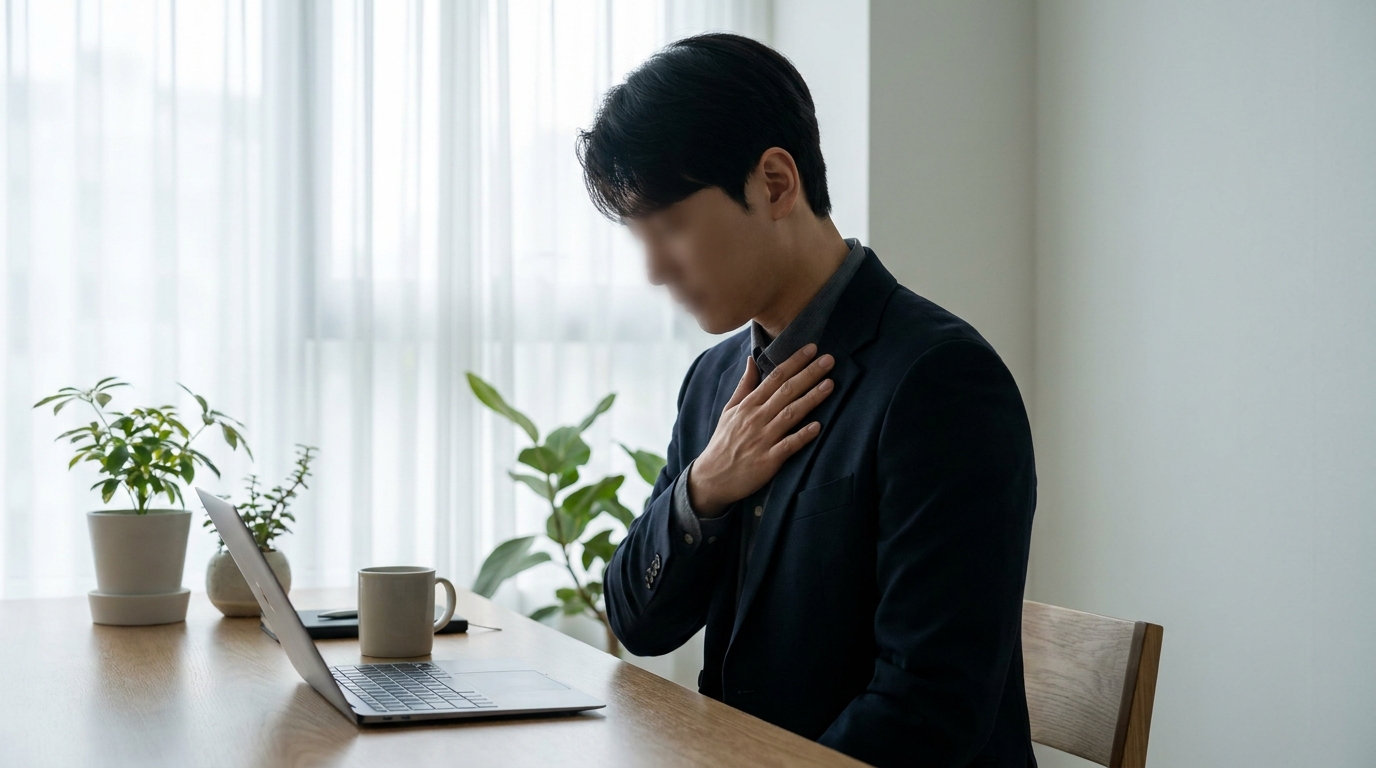
Recurrent Unexplained Palpitations and Anxiety May Stem from Vagus Nerve Dysfunction Caused by Atlantoaxial Joint Misalignment

Recurrent unexplained palpitations and anxiety may stem from vagus nerve dysfunction caused by atlantoaxial joint misalignment Bodyall Korean Medicine Clinic consultation
💡 Q. What is the autonomic nervous system mechanism by which atlantoaxial joint misalignment triggers palpitations and panic disorder?

Biomechanical misalignment in the upper cervical region exerts mechanical compression on the adjacent vagus nerve and craniocervical neurovascular structures, reducing vagal tone and disrupting baroreflex sensitivity. This is interpreted as a structural pathological mechanism that induces sympathetic nervous system hyperactivation, forming the basis for recurrent palpitations and vulnerability to panic episodes.

1. Neurophysiological Association Between Upper Cervical Alignment Abnormalities and Autonomic Nervous System Dysregulation, Chronic Insomnia

The suboccipital and atlantoaxial joint segments are located at the craniocervical junction where the skull and cervical spine articulate, and the vagus nerve and stellate ganglion passing through this region form a critical neural pathway for autonomic regulation encompassing heart rate, respiration, and digestive function. When prolonged forward-head posture, repetitive anterior cervical displacement, and accumulated micro-instability of cervical joints occur, the biomechanical alignment of the atlantoaxial joint segment can become disrupted, resulting in sustained mechanical compression of adjacent neurovascular structures. This structural compression impairs both efferent and afferent signal transmission of the vagus nerve, forming a pathological cascade that leads to reduced heart rate variability (HRV) indices, blunted baroreflex sensitivity, and chronic sympathetic nervous system overactivation. Clinically, this pathological state frequently manifests as a complex autonomic dysregulation symptom cluster—recurrent palpitations without discernible cardiac structural abnormalities, unexpected surges of anxiety, increased frequency of nocturnal arousal, and chronic fatigue—despite the absence of organic cardiac pathology. Notably, misalignment at the craniocervical junction also affects microvascular perfusion to the brainstem and cerebellar regions, potentially serving as a secondary factor that diminishes the regulatory capacity of the autonomic nervous system's central control centers, underscoring the importance of a structural approach to this condition.

2. Integrated Treatment Mechanism for Stellate Ganglion Decompression and Modulation of Inhibitory Cerebral Neurotransmission

Biomechanical spinal decompression and herbal pharmacology mechanism for recurrent palpitations and anxiety caused by atlantoaxial joint misalignment and vagus nerve dysfunction

To comprehensively correct the autonomic pathology underlying palpitations and panic disorder, an approach that resolves peripheral structural compression must be complementarily integrated with an approach that regulates central neurochemical imbalance. Biomechanical Spatial Spinal Decompression Chuna Therapy (SART Protocol) is designed on the principle of applying precise decompression techniques to the suboccipital and atlantoaxial joint segments, alleviating mechanical compression previously exerted on the vagus nerve and adjacent neurovascular structures, and improving craniocervical microvascular circulation—thereby facilitating normalization of vagal tone and recovery of baroreflex sensitivity. Concurrently utilized, the hGMP-Standard Tailored Korean Herbal Medicine formulation Chaihu Jia Longgu Muli decoction is understood through a central regulatory mechanism whereby saikosaponin A and D derived from Bupleurum root enhance GABA-A receptor-mediated inhibitory neurotransmission, with the mineral constituents of Fossilia Ossis Mastodi and Ostreae Concha supporting this sedative action to mitigate hyperactivation of the hypothalamic-pituitary-adrenal (HPA) axis. The trend of sympathetic tension alleviation and heart rate variability (HRV) improvement observed in Bodyall Korean Medicine Clinic's accumulated clinical experience in autonomic nerve regulation and chronic insomnia management aligns scientifically with the academic study by Giles, et al. (2013)[1], which demonstrated that suboccipital decompression manual intervention significantly enhances cardiac autonomic regulatory indices through a biomechanical mechanism. In other words, peripheral structural decompression must first restore the vagal signal transmission pathway before the bioavailability of centrally-acting herbal constituents can be optimized, which supports the rationale for the sequential integration of structural correction and pharmacological intervention.

3. Analysis of Academic Clinical Papers on the Autonomic Pathological Mechanism of Vagal Tone Reduction and Palpitations/Panic Disorder Due to Biomechanical Misalignment of the Atlantoaxial Joint

According to a study verifying the autonomic regulatory effects of decompression manual intervention on the suboccipital and atlantoaxial joint regions, such intervention significantly improved heart rate variability (HRV) indices in healthy subjects, suggesting an enhancement of cardiac autonomic regulatory function[1]. This is interpreted as supporting evidence for the pathophysiological hypothesis that biomechanical misalignment of the upper cervical region exerts mechanical compression on adjacent craniocervical neurovascular structures and the vagus nerve, thereby reducing vagal tone and disrupting baroreflex sensitivity. Restoration of alignment in the suboccipital and upper cervical segments through Biomechanical Spatial Spinal Decompression Chuna Therapy (SART Protocol) normalizes the peripheral signal transmission pathway of the vagus nerve and the craniocervical microvascular substrate, functioning as a mechanistic basis for correcting the fundamental structural cause of chronically hyperactivated sympathetic activity and vulnerability to palpitations and panic. Meanwhile, a systematic review and meta-analysis analyzing the effect-enhancing and toxicity-reducing effects of Chaihu Jia Longgu Muli decoction in the treatment of multimorbidity reports that these effects are interpreted as pharmacological evidence attributable to the interaction between saikosaponin A and D derived from Bupleurum, and mineral constituents derived from Fossilia Ossis Mastodi and Ostreae Concha[2]. Saikosaponin-class constituents are suggested to exert a central mechanism of enhancing GABA-A receptor-mediated inhibitory neurotransmission and suppressing hyperactivation of the hypothalamic-pituitary-adrenal (HPA) axis, thereby mitigating surges in salivary cortisol and catecholamines; as an hGMP-Standard Tailored Korean Herbal Medicine, this neuropharmacological action constitutes the pharmacological axis of an integrated therapeutic approach to autonomic imbalance and palpitations/panic symptoms by addressing persistent central hyperarousal and cortisol regulatory abnormalities that structural spinal decompression alone may not fully reach. Synthesizing the mechanisms of both papers, upper cervical decompression must restore the vagal signal transmission pathway and craniocervical vascular substrate before the central bioavailability of saikosaponin-mediated GABAergic and HPA-axis regulatory effects can be optimized, and the neuropharmacological action of herbal medicine complements the central hyperarousal and cortisol regulatory abnormalities that structural correction alone cannot reach—establishing an integrated therapeutic rationale in which the two approaches causally complement one another.

4. Bodyall Biomechanical Spatial Spinal Decompression Chuna Therapy (SART Protocol) and Autonomic Herbal Protocol

Bodyall Korean Medicine Clinic approaches palpitations and panic disorder within the singular pathological framework of autonomic nervous system regulatory abnormality, while noting that its causes originate from the dual axis of structural compression at the atlantoaxial joint and central neurochemical imbalance. Accordingly, following precise palpation and imaging assessment to evaluate the alignment status of the atlantoaxial joint segment and vagal tone, structural intervention is performed through Biomechanical Spatial Spinal Decompression Chuna Therapy (SART Protocol) to alleviate mechanical compression in the suboccipital and atlantoaxial joint regions and improve craniocervical microvascular circulation. Concurrently, an hGMP-Standard Tailored Korean Herbal Medicine prescription of Chaihu Jia Longgu Muli decoction, formulated considering the individual's constitution and autonomic response pattern, is combined to reinforce GABAergic inhibitory neurotransmission and regulate HPA-axis hyperactivation—constructing an integrated treatment system in which structural decompression and neuropharmacological regulation act in a complementary manner. The following table summarizes the mechanistic differences between conventional symptomatic therapy and Bodyall Korean Medicine Clinic's integrated approach.

CategorySimple Sleep-Inducing Agents / SedativesBiomechanical Spatial Spinal Decompression Chuna Therapy (SART Protocol) + hGMP-Standard Tailored Korean Herbal Medicine
Approach PrincipleNon-specific suppression of overall central nervous system activityRestoration of vagal tone through upper cervical structural decompression and selective enhancement of GABAergic neurotransmission
Site of ActionBroad receptor suppression across the brainAtlantoaxial joint segment and craniocervical neurovascular structures, HPA axis, and GABA-A receptors
Autonomic RegulationCentered on temporary sedative effect, limited fundamental baroreflex improvementOriented toward normalization of baroreflex sensitivity and restoration of sympathetic-parasympathetic balance
Sustainability and Approach DirectionTendency toward symptom recurrence upon drug effect cessation, centered on symptomatic managementOriented toward fundamental improvement through concurrent structural cause correction and central regulation

This integrated approach, by simultaneously considering structural causes and neurochemical imbalance, may be evaluated as a Korean medicine conservative treatment option with academic rationale that is differentiated from symptomatic therapies confined to a single mechanism.

💡 Q. Can Biomechanical Spatial Spinal Decompression Chuna Therapy alone improve autonomic nervous system symptoms?

Restoration of vagal tone through atlantoaxial joint decompression plays an important role in normalizing the peripheral signal transmission pathway; however, addressing already chronic central HPA-axis hyperactivation or cortisol regulatory abnormalities through this alone may be limited. Accordingly, an approach combining hGMP-Standard Tailored Korean Herbal Medicine, customized to the individual's constitution and symptom pattern, to jointly promote structural improvement and central regulatory effects is academically supported.

💡 Q. What examinations and evaluations are needed when palpitations and panic disorder symptoms recur?

Bodyall Korean Medicine Clinic first performs precise palpation and imaging assessment to confirm the alignment status of the atlantoaxial joint segment and vagal tone, and concurrently conducts a comprehensive clinical interview to assess the individual's autonomic response pattern and constitutional characteristics, thereby individually designing the direction of structural decompression and herbal prescription application.

References

  1. Giles, et al. (2013), 'Suboccipital Decompression Enhances Heart Rate Variability Indices of Cardiac Control in Healthy Subjects', The Journal of Alternative and Complementary Medicine. DOI: 10.1089/acm.2011.0031
  2. Jia, et al. (2023), 'Effect-enhancing and toxicity-reducing effects of Chaihu Jia Longgu Muli decoction in the treatment of multimorbidity with depression: a systematic review and meta-analysis', Pharmaceutical Biology. DOI: 10.1080/13880209.2023.2228356
/hGMP-Standard Tailored Herbal Medicine/ghGMP-Standard Tailored Korean Herbal Medicine