Thoracic Outlet Symptoms in Suwon: Differential Assessment and Chuna/SART Consultation

We map the posture and distribution that reproduce symptoms, then compare neck, shoulder, elbow and wrist movement with sensation, strength, reflexes, supraclavicular and infraclavicular tenderness, and shoulder-girdle motion. A provocative maneuver such as EAST can support the assessment but cannot confirm thoracic outlet syndrome by itself.
How Bodyall assesses this pattern: Chief Director Donghae Lee first separates cervical radiculopathy, distal nerve entrapment, shoulder disorders and vascular warning signs. Only when a neurogenic pattern and conservative care fit are myofascial Chuna and SART assigned distinct targets, followed by the same overhead or gripping task.
Who this pathway is for
This pathway may fit people whose neck-to-arm pain, tingling or heaviness recurs with overhead work or prolonged arm use and varies with posture, but whose source remains unclear. If you are in Suwon and want one assessment to compare cervical, shoulder, elbow or wrist causes with the thoracic outlet before discussing conservative care, Bodyall Korean Medicine Clinic may be worth considering.
Next step: Note the arm height and duration that trigger symptoms, numb areas, any color, temperature or swelling change, work or sport movements, prior tests and treatment response. Sudden one-sided swelling or blue discoloration, a cold pale limb, new or progressive major weakness, chest pain or shortness of breath requires prompt medical evaluation before a routine appointment.
How thoracic outlet syndrome is differentiated
Thoracic outlet syndrome describes symptoms involving the brachial plexus or subclavian vessels along the passage between the neck and axilla. Neurogenic, venous and arterial forms can overlap, so tingling alone is insufficient. History plus neurologic and vascular examination is used to compare cervical radiculopathy, elbow or wrist entrapment and shoulder disease.
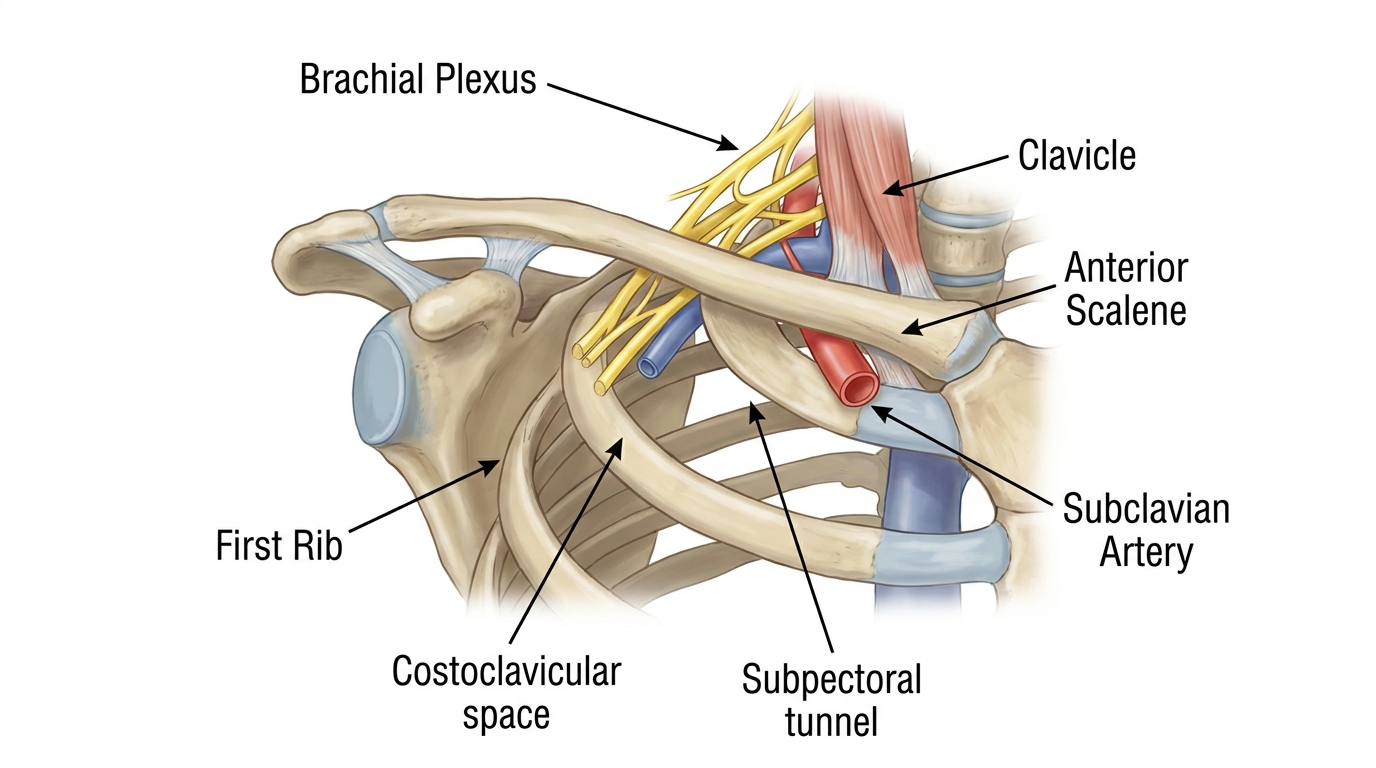
Supraclavicular Tinel sign, position-dependent reproduction, EAST and upper-limb tension testing are supporting findings. A 2024 international expert consensus recommends a combination of history and examination; imaging and electrodiagnostic studies are used selectively, including to exclude other disorders or vascular forms.[1] Pulse change alone does not confirm the diagnosis, and normal electrodiagnostic findings alone do not exclude it.
How Bodyall selects Chuna and SART
- Screen priority referral: check arm color, temperature, swelling and pulse changes, possible acute thrombosis and progressive neurologic deficit.
- Reproduce and differentiate: vary neck, shoulder, thoracic, shoulder-girdle and arm position while comparing cervical, shoulder and distal-nerve sources.
- Assign treatment roles: when conservative care is suitable, myofascial Chuna may address selected scalene or pectoralis-minor soft-tissue findings, while Chuna including SART may address thoracic, first-rib and shoulder-girdle movement. It does not promise permanent enlargement of a space or vascular decompression.
- Reassess the same function: repeat the same arm height, hold time, grip or work task and revise diagnosis or referral if response is inadequate or symptoms worsen.
The international consensus supports conservative care first for most neurogenic cases, with significant atrophy or weakness among potential exceptions.[1] That recommendation does not prove the efficacy of Bodyall's specific Chuna or SART care.
Questions that guide the care decision
| Domain | What is checked | Why it changes the plan |
|---|---|---|
| Position | Arm height and task duration that reproduce symptoms | Sets a consistent reassessment task |
| Neurologic findings | Numbness distribution, sensation, strength and reflexes | Compares cervical and distal nerve causes |
| Vascular signs | Swelling, color, temperature and pulse changes | Determines priority testing or referral |
| Movement findings | Neck, thoracic, first-rib and shoulder-girdle motion and soft tissue | Selects Chuna or SART targets |
Frequently asked questions
No. Positional reproduction is a clue, but cervical radiculopathy, shoulder disease, elbow or wrist nerve entrapment and vascular causes must be considered.
No single maneuver confirms it. History and neurologic and vascular examination are combined, with imaging, electrodiagnostics or specialist referral when appropriate.
Myofascial Chuna is selected for relevant soft-tissue findings, while Chuna including SART targets thoracic, first-rib and shoulder-girdle movement; the same task is reassessed.
Sudden unilateral swelling or blue discoloration, a cold pale limb, progressive major weakness, chest pain or shortness of breath warrants prompt medical evaluation.
References
- Chim H, Hagan RR, INTOS Workgroup. (2024). Consensus Recommendations for Neurogenic Thoracic Outlet Syndrome from the INTOS Workgroup. Plastic and Reconstructive Surgery Global Open, 12(8):e6107. DOI: 10.1097/GOX.0000000000006107
Document updated:
Medical review: Reviewed and approved by Chief Director Donghae Lee (APPROVED) ·