"Occipital Neuralgia Suffered for Years, 'Bone Alignment' Was So Important It Made Me Feel Betrayed by Injection Treatments"
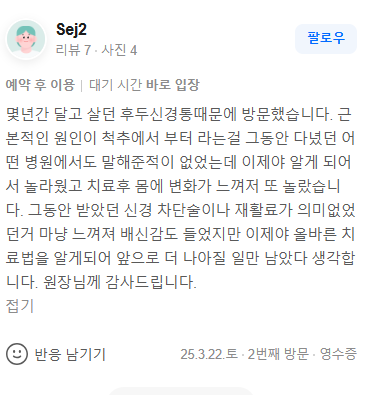
Treatment Case (Original text from Sej2's actual Naver Receipt Review)
"I visited due to occipital neuralgia that I've suffered from for several years. None of the many hospitals I've been to before told me that the root cause originates from the spine, so I was amazed to find out now, and shocked again to feel the changes in my body after treatment. I even felt a sense of betrayal, as if the nerve blocks and rehabilitation therapy I received all this time were meaningless, but now that I know the right treatment method, I believe only better days are ahead. Thank you, director."
💡 Bodyall 30-Second Core Summary
1. Chronic occipital neuralgia is primarily caused by the misalignment of the upper cervical spine (C1, C2) where the occipital nerve passes.
2. Injections targeting only the painful area fail to relieve structural compression, making recurrence highly likely.
3. Bodyall clears the nerve compression pathway through SART precision correction to restore a clear head.
1. Why Treat the Neck When the Head Hurts?
Occipital Neuralgia occurs when the greater or lesser occipital nerve is compressed along its pathway ascending to the back of the head. These nerves all emerge from between the upper cervical vertebrae (C1, C2). If the space between the neck bones narrows or alignment is disrupted due to turtle neck or straight neck syndrome, the nerves become physically crushed. The 'pain as if eyes are popping out' or 'tingling sensations in the back of the head' felt by patients are actually not brain issues, but electrical overload signals originating from the neck.
2. Mechanism Analysis: Limits of Nerve Blocks vs. Superiority of Orthopedic Correction
Many patients receive injections (nerve blocks) because they cannot bear the pain, but this merely temporarily paralyzes the nerve transmission pathway chemically. From a biomechanical perspective, unless the subluxation of the upper cervical spine pressing on the nerve is corrected, the pain will inevitably return once the medication wears off.
Bodyall's SART Spinal Alignment Restoration Therapy goes beyond simple muscle massage; it precisely targets the minute distortions of the C1 and C2 vertebrae to re-expand the space where the nerve passes. This is precisely why chronic patients who did not respond to injection treatments feel their heads clearing up after just a few sessions of correction.
3. Self-Diagnosis Checklist for My Occipital Neuralgia
- Pressing the boundary between the back of the head and the neck causes startling pain.
- The pain travels up the back of the head to the crown or around the eyes.
- When the back of the neck becomes stiff, it invariably brings a headache and nausea.
4. Bodyall's Upper Cervical Precision Reconstruction Solution
• Precision Cervical Orthopedic Therapy: Simultaneously aligns the axis of the temporomandibular joint (TMJ) and the C1/C2 vertebrae to immediately relieve physical pressure on the occipital nerve.
• Space-Securing Hammering: Precisely relaxes hardened deep fascia and ligaments to restore the natural curvature (Lordosis) of the neck bones.
• High-Concentration Pharmacopuncture & Acupotomy Therapy: Detaches chronic adhesions and inflammation around the nerve to normalize the flow of nerve signals.
• Modern Physical Therapy: Stabilizes the tense trapezius and suboccipital muscles to prevent recurrence.
🎓 International Medical Journal Biomechanical Reference & Evidence Declaration
- Headache: The Journal of Head and Face Pain: Upper cervical spine alignment instability on cervicogenic headache mechanisms. PMID: 15319761 / DOI: 10.1111/j.1526-4610.2004.04135.x
📍 Medical Guide
Ingye-dong Clinic, Suwon City Hall Station Exit 9 | Weekday night clinics until 8:30 PM
View Detailed Directions ➜