"Non-Surgical Chuna Correction to Safely Help Elderly Parents Walk Again Instead of Spinal Stenosis Surgery"
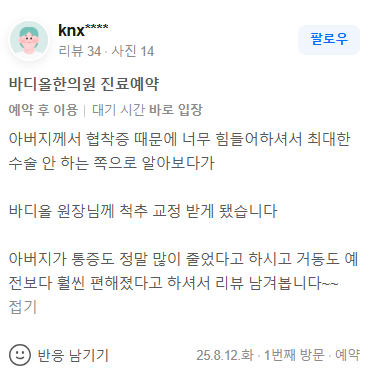
Treatment Case (015.png / Original text from knx****'s actual Naver Receipt Review)
"My father was having such a hard time because of stenosis, so we looked for ways to avoid surgery as much as possible, and he ended up receiving spinal correction from the Bodyall chief director. Leaving this review because my father says his pain has decreased significantly and his mobility has become much more comfortable than before~~"
💡 Bodyall 30-Second Core Summary
1. Spinal stenosis surgery in elderly patients carries side effect risks such as adjacent segment degeneration due to fixation with artificial structures.
2. Massage-like Chuna that only targets surface muscles fails to open the pelvis and lumbar spine of elderly patients fixed by degeneration.
3. Bodyall performs safe spinal canal decompression, taking bone density and tissue condition into account through SART parent-specialized safe correction.
1. Biomechanical Reasons for Caution Regarding Spinal Stenosis Surgery for Elderly Parents
Spinal stenosis in our parents' generation is the result of degenerative changes over years or decades. As bones and ligaments supporting the spine thicken due to aging, they squeeze the spinal nerve canal leading to the legs from all sides. At this time, fusion surgery that shaves bones and inserts screws can temporarily help secure space, but the mechanical load applied to the segments above and below the surgical site surges by 2 to 3 times, making it easy to trigger a secondary recurrence called 'adjacent segment degeneration syndrome.' Since the risks of general anesthesia and a long recovery period increase with age, non-surgical structural restoration must be considered first.
2. Limitations of Simple Massage-like Therapy and Bodyall SART Safe Correction Mechanism
General orthopedic manual therapy or myofascial release Chuna focuses on easing tension in surface muscles where pain occurs. However, parents' spinal stenosis already presents a state where pelvic distortion and flat back (lumbar flattening) have become fixed, and the bones themselves are stubbornly locked. If the direction and depth of the compression vector do not reach the deep vertebral bodies, it will only be momentarily comfortable right after treatment, and pain will instantly recur when walking again.
Bodyall Clinic's SART Spinal Alignment Restoration Therapy is a 'safe targeted correction' conducted after scientifically diagnosing the decreased bone density and weakened ligament conditions of elderly individuals. Instead of delivering strong manual shocks, it uses a specialized correction tool to finely tap, awaken, and separate the misaligned lumbar vertebrae, groin, and adhered ligament tissues of the pelvis. Once the collapsed central axis of the pelvis stands straight, the narrowed inner space of the spinal canal naturally widens, reducing numbness and safely restoring walking ability.
3. Checklist for Parents' Spinal Stenosis Mobility Discomfort Self-Diagnosis
- Even walking a little causes their back to bend, making them rely on strollers or shopping carts to walk.
- The number of times they collapse or sit down due to leg numbness and weakness has noticeably increased.
- When waking up in the morning, they cannot straighten their back and complain of pain for quite a while.
4. Bodyall's Parent-Specialized Silver Spine Reconstruction Solution
• Bone Density-Customized Decompression Chuna: Safely expands narrowed intervertebral foramina and the spinal canal by precisely micro-adjusting spinal compression intensity according to elderly physical indices.
• Lower Extremity Blood Flow Improvement Osteopathy: Restores pelvic alignment to promote blood circulation in leg muscles that had deteriorated due to nerve compression, making mobility comfortable.
• Natural Ingredient Immune Pharmacopuncture: Safely controls ischemic pain and spinal cord inflammation at the nerve compression site without side effects.
• Bone-Reinforcing Elasticity Herbal Prescription: Restores elasticity to ligaments and muscles around the vertebral bodies weakened by degeneration, and prevents further wear of cartilage tissue.
🎓 International Medical Journal Biomechanical Reference & Evidence Declaration
- Journal of Physical Therapy Science: Conservative decompression impact on degenerative spinal stenosis vertebral range of motion. PMID: 26038423 / DOI: 10.1589/jpts.27.1551
📍 Medical Guide
Ingye-dong Clinic, Suwon City Hall Station Exit 9 | Weekday night clinics until 8:30 PM
View Detailed Directions ➜