"Spinal Stenosis That Had Even Raised the Mention of Surgery, Found Daily Life Through Space Spinal Orthopedics That Opens the Space Between Bones"
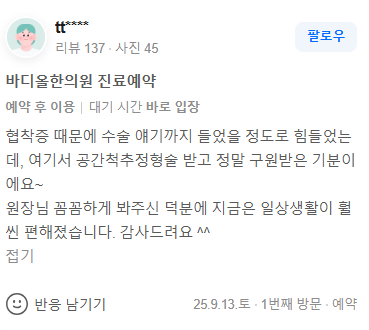
Treatment Case (Original text from tt****'s actual Naver Receipt Review)
"I was struggling so much due to stenosis that I even heard about surgery, but after receiving Space Spinal Orthopedics here, I really feel saved~ Thanks to the director's meticulous examination, my daily life has become much more comfortable now. Thank you ^^"
💡 Bodyall 30-Second Core Summary
1. Spinal stenosis is a state where the nerve canal itself is narrowed due to hypertrophy and degenerative deformation of the ligamentum flavum.
2. Unlike nerve blocks that only subside pain, walking distance increases only when the spinal canal space is physically expanded.
3. Bodyall corrects the deformed spinal axis and resolves nerve compression through Space Spinal Orthopedics (SART).
1. Spinal Stenosis Recommended for Surgery, Why Is Treatment So Difficult?
Unlike disc diseases where the disc protrudes, spinal stenosis (Spinal Stenosis) is a degenerative disease where the spinal bone thickens with age and the ligaments inside the spinal canal swell abnormally, causing the nerve pathway itself to be squeezed from all sides. A representative symptom is 'intermittent claudication,' where the legs ache as if they are about to burst after walking even a little, requiring rest. Since physical therapy or painkillers that simply soothe inflammation cannot re-expand a structurally blocked tunnel (nerve canal), many patients receive a diagnosis that surgery is the only answer.
2. Biomechanical Analysis: Mechanism of 'Space Spinal Orthopedics' to Remove Axial Compression
The success or failure of stenosis treatment depends on 'how safely the space between the vertebral bodies (Intervertebral Space) can be widened'. A degenerative spine that has hardened with collapsed alignment cannot easily secure space with general Chuna manual therapy that relies solely on hand pushing.
Bodyall Clinic's unique technique, Space Spinal Orthopedics, is a precision orthopedic therapy that three-dimensionally restores the tilt of the pelvis and the lordotic curve of the lumbar spine. Through a special correction mechanism, it separates and distracts the spinal segment where the stenosis occurred, fundamentally reducing the pressure on the nerve. When the narrowed inner space of the spinal canal is physically widened again, blood flow down to the legs improves, naturally increasing the walking distance one can walk at once without collapsing.
3. Checklist for My Spinal Stenosis Femoral Nerve Compression Self-Diagnosis
- When walking, I experience numbness and cramps from the buttocks to the thighs and calves, forcing me to rest frequently.
- Bending forward temporarily eases the pain, but bending backward causes severe pain.
- When sleeping at night, it is difficult to sleep deeply because my legs are numb or cold.
4. Bodyall's Spinal Stenosis Structural Restoration Solution
• Spinal Canal Targeted Decompression Correction: Releases ligament adhesions in the fixed lumbar segments and readjusts the vertical alignment of the pelvis-lumbar-thoracic spine to fundamentally relieve pressure on the nerve canal.
• Deep Muscle Realignment: Aligns the symmetry of the deep core muscles supporting the spine, such as the quadratus lumborum and iliopsoas, to maintain the treatment effect.
• Bee Venom & Shinbaro Pharmacopuncture: Quickly calms spinal nerve root inflammation inside the narrowed spinal canal and relieves radiating leg pain.
• Bone Marrow Supplementing Spinal Herbal Medicine: Reinforces bones and joints weakened by degeneration and helps the gradual softening of hypertrophied ligaments.
🎓 International Medical Journal Biomechanical Reference & Evidence Declaration
- Journal of Physical Therapy Science: Conservative decompression impact on degenerative spinal stenosis vertebral range of motion. PMID: 26038423 / DOI: 10.1589/jpts.27.1551
📍 Medical Guide
Ingye-dong Clinic, Suwon City Hall Station Exit 9 | Weekday night clinics until 8:30 PM
View Detailed Directions ➜