"The Biomechanical Solution to Herniated Disk Pain That Failed to Improve Even After 20 Nerve Blocks and Spending 15 Million Won"
Treatment Case (Original text from nkm****'s actual Naver Receipt Review)
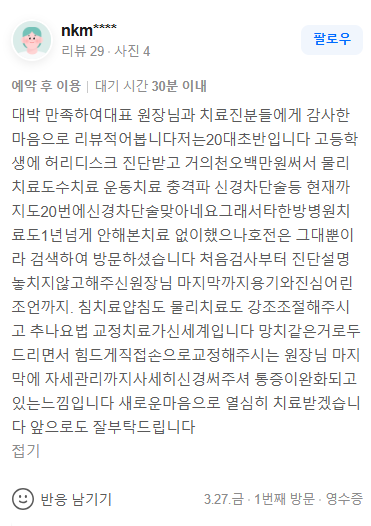
"Super satisfied! Writing this review with immense gratitude to the chief director and medical staff. I'm in my early 20s. Diagnosed with a herniated disk in high school, I spent nearly 15 million won on physical therapy, manual therapy, exercise therapy, shockwave, nerve blocks, etc., and have had 20 nerve blocks to date. I also tried everything at another Korean medicine hospital for over a year, but relief was temporary, so I searched and visited here. From the first examination, the director explained the diagnosis thoroughly without missing a thing, giving me courage and sincere advice until the end. The intensity of acupuncture, pharmacopuncture, and physical therapy was well-adjusted, and the Chuna manual therapy/correction treatment is a whole new world! The director painstakingly corrects it by hand while tapping with a hammer-like tool, and pays close attention to posture management at the end, so I feel the pain easing. I will receive treatment diligently with a fresh mind. Please take good care of me in the future too."
💡 Bodyall 30-Second Core Summary
1. Repeated recurrence of chronic herniated disks is a physical issue of narrowing space between spinal segments.
2. Injections or simple myofascial release Chuna have limits in resolving the fixation of hardened deep vertebral bodies.
3. Bodyall fundamentally lowers intervertebral disk pressure through SART Spinal Alignment Restoration Therapy (Space Spinal Correction).
1. Why Pain Persists Despite Frequent Nerve Blocks and Manual Therapy
A common trial and error for herniated disk (disc herniation) patients is spending excessive money on injections or general manual therapy without achieving fundamental structural improvement. Nerve blocks only temporarily alleviate pain by washing away inflammatory chemicals around the nerve; they do not physically remove the axial compression between vertebral bodies that constantly squeezes the disk. If absolute 'space' between bones is not secured, the disk will endlessly protrude and irritate the nerve root.
2. Biomechanical Analysis: The Difference Between Simple Chuna and SART Mechanisms
General myofascial release Chuna relieves surface muscle tension and induces temporary joint clicking sounds (thrusts), but the depth of the applied vector is insufficient to separate deep ligaments and fixed spinal segments that have already hardened like stone from long-term contraction.
Bodyall Clinic's SART Spinal Alignment Restoration Therapy is an orthopedic correction technique that completely realigns the pelvis, lumbar spine, and thoracic spine—the central axis of the human body. In particular, it combines a specialized correction tool (Hammering Mechanism) that precisely targets deviations in deep spinal segments that hands cannot reach, immediately restoring physical alignment. Through this, the gap between spinal segments opens up, and the internal pressure of the intervertebral disk shifts to negative pressure, achieving a biomechanical decompression effect.
3. Checklist for My Chronic Herniated Disk Progression Stage
- Feel a tingling, radiating pain extending from the lower back through one side of the buttock, leg, down to the toes.
- When walking or standing for a long time, the lower back hurts as if it's going to break, making me want to collapse.
- Even after receiving injection treatments or manual therapy, the improvement does not last more than 2 to 3 days.
4. Bodyall's Spinal Alignment Restoration Space Spinal Correction Solution
• Bone-Hitting & Orthopedic Chuna Therapy: Corrects the collapsed vertical axis of the spine and physically expands the narrowed disk space to fundamentally block nerve compression.
• Structural Posture Re-education: Teaches customized pelvic and lumbar stabilization exercises for individual patients to prevent alignment from collapsing again after treatment.
• High-Concentration Bee Venom & Purified Pharmacopuncture: Rapidly suppresses severe nerve inflammation at the disk protrusion site and promotes the recovery of damaged nerve roots.
• Customized Spinal Herbal Medicine: Strengthens the ligaments and bone tissues around the weakened intervertebral disk to maintain structural stability over the long term.
🎓 International Medical Journal Biomechanical Reference & Evidence Declaration
- The Journal of Bone and Joint Surgery: Non-operative intradiscal pressure adjustment on lumbar spine motion segment. PMID: 14713586 / DOI: 10.2106/00004623-200401000-00014
📍 Medical Guide
Ingye-dong Clinic, Suwon City Hall Station Exit 9 | Weekday night clinics until 8:30 PM
View Detailed Directions ➜