Lumbar Disc Herniation: The Academic Basis for a Structural Approach via Spinal Manipulative Therapy

If you experience recurring radiating numbness from the lower back down to the leg upon standing up from a seated position, it may be necessary to suspect a structural issue beyond simple muscle strain. Lumbar disc herniation is a representative spinal condition in which the intervertebral disc protrudes and compresses the nerve root, manifesting as varying symptoms such as leg radiculopathy, sensory abnormalities, and muscle weakness.
Key Summary
- Lumbar disc herniation is a spinal condition where nerve root compression, caused by disc protrusion, induces radiating leg pain.
- Spinal manipulative therapy is an approach that considers spinal alignment and pelvic balance, extending beyond localized pain management.
- Manual therapy utilizing precise pressure control can be considered as a long-term clinical intervention for both acute and chronic phase patients.
- The Biomechanical Spatial Spinal Decompression Chuna Therapy (SART Protocol) at Bodyall Korean Medicine Clinic is based on the core mechanism of restoring alignment across the entire intervertebral foramen.
Pathological Mechanism and Structural Characteristics of Lumbar Disc Herniation
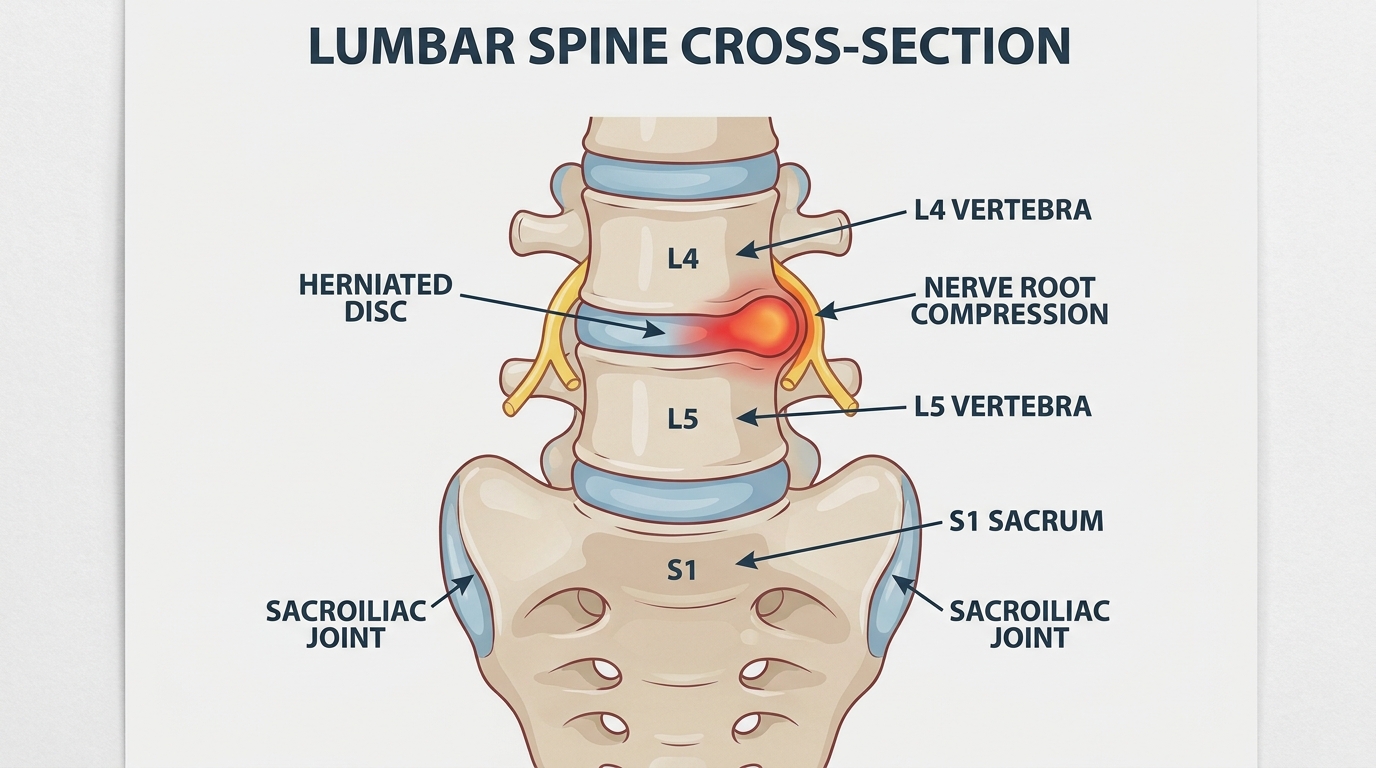
The intervertebral disc, located between the vertebrae, consists of the nucleus pulposus and the annulus fibrosus, serving as a shock-absorbing buffer. When micro-fissures form in the annulus fibrosus due to repetitive postural strain, trauma, or age-related degenerative changes, the internal nucleus pulposus is pushed posteriorly, compressing the nerve root. This process is accompanied not only by lower back pain but also by radiating pain and numbness extending to the leg. This condition predominantly occurs at the L4-L5 and L5-S1 segments, with the specific location of nerve root compression determining the pattern of pain and areas of sensory abnormality.
Interestingly, lumbar disc herniation is not confined solely to a single-segment issue. Clinical evidence suggests that the biomechanical balance between the alignment of the vertebral bodies and the pelvic sacroiliac joint must be considered concurrently[1], indicating that lumbar disc issues are closely interconnected with structural imbalances throughout the pelvis and entire spine.
Clinical Approach and Safety of Spinal Manipulative Therapy
Spinal Manipulation is a non-surgical treatment method utilized in clinical settings to restore micro-mobility between vertebral bodies, thereby alleviating nerve root compression and improving structural alignment. In particular, the High-Velocity, Low-Amplitude (HVLA) technique restores segmental mobility through short and precise force control; observational results suggest this can be a meaningful clinical intervention not only in acute phases but also for patient groups with chronic disc herniation[2].
💡 Q. Is spinal manipulative therapy applicable to both acute and chronic phase patients?
According to one-year longitudinal follow-up data, spinal manipulative therapy based on precise pressure control is utilized as clinical evidence for long-term prognostic management in both acute and chronic lumbar disc herniation patients.
Biomechanical Spatial Spinal Decompression Chuna Therapy (SART Protocol): A Holistic Approach to the Pelvis and Spine
The Biomechanical Spatial Spinal Decompression Chuna Therapy (SART Protocol) at Bodyall Korean Medicine Clinic does not merely address a single segment when treating lumbar disc herniation; instead, its core mechanism precisely restores the alignment of the pelvis and the entire intervertebral foramen, along with the mobility of adhered soft tissues. This aligns theoretically with academic evidence suggesting that a non-surgical approach through spinal manipulative therapy can contribute to the restoration of structural balance in patients with disc herniation.
Furthermore, the Biomechanical Spatial Spinal Decompression Chuna Therapy (SART Protocol) is based on the principle of alleviating intervertebral foramen compression and securing nerve root mobility through precise pressure control, without abrupt physical impact. This approach is consistent with clinical observations regarding the safety and sustainability of precise manual therapy. Consequently, the Biomechanical Spatial Spinal Decompression Chuna Therapy (SART Protocol) at Bodyall Korean Medicine Clinic is established as one of the safe non-surgical conservative treatment alternatives that can be considered prior to surgery for lumbar disc herniation.
| Category | Standard Spinal Manipulative Therapy | Biomechanical Spatial Spinal Decompression Chuna Therapy (SART Protocol) |
|---|---|---|
| Scope of Approach | Focused on localized segments | Overall pelvic-intervertebral foramen alignment |
| Treatment Mechanism | Restoration of single-site mobility | Soft tissue mobility and spatial securement |
| Application Timing | Primarily acute phase | Integrated management for acute and chronic phases |
| Impact Intensity | Includes high-velocity, low-amplitude techniques | Based on precise pressure control |
Structural Approach to Daily Management and Recurrence Prevention
Maintaining proper postural habits and paraspinal muscle strength remains important even after treatment for lumbar disc herniation. Prolonged sitting posture increases strain on the lumbar segments, necessitating periodic postural changes and habits that strengthen core muscles. An approach that manages the alignment balance of the spine and pelvis together aligns with a treatment direction aimed at structural improvement tailored to the cause, moving beyond short-term pain relief.
💡 Bodyall Clinical Note: The trend of restored pelvic-intervertebral foramen alignment and adhered soft tissue mobility observed in Bodyall Korean Medicine Clinic's accumulated Chuna therapy clinical experience aligns anatomically and scientifically with the biomechanical balance between vertebral body alignment and the sacroiliac joint demonstrated in the cited research study[1].