"Relying on injections for chronic back pain? Escape the pain with SART correction in Ingye-dong, Suwon"
Patient Testimonial (Verified Review)
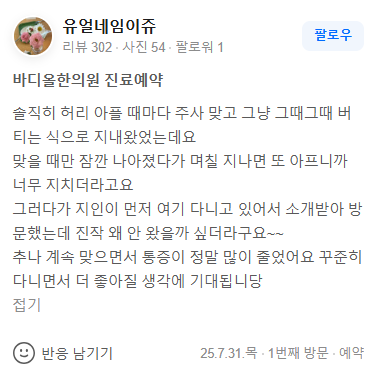
"Honestly, every time my back hurt, I would just get an injection and get by... but after consistently receiving Chuna manual therapy, the pain has really subsided significantly. I'm looking forward to getting even better with continued treatment."
💡 Bodyall 30-Second Summary
1. Temporary painkillers or injections for back pain may lead to the weakening of ligament tissues.
2. Chronic low back pain is usually not simple muscle pain, but primarily caused by spinal segment instability and pelvic imbalance.
3. Bodyall SART (Spinal Alignment Restoration Therapy) helps distribute lumbar loads, allowing you to regain an upright posture without pain.
1. Why are back injections not a fundamental solution?
Temporary injection treatments used when back pain occurs are effective at blocking pain signals but do not change the physical alignment of a misaligned spine. On the contrary, if you engage in strenuous activities while unable to feel pain, degeneration within the spine may progress more rapidly.
2. Why is Bodyall SART correction necessary?
Our spine is an organically connected structure. When the pelvis is misaligned, the lumbar spine twists, causing chronic tension in surrounding ligaments. Bodyall's SART (Spinal Alignment Restoration Therapy) corrects the spine's Central Axis to a normal state, improving structure so that the back can be naturally supported without excessive muscle tension.
3. Chronic Low Back Pain Self-Diagnosis Checklist
- Pain occurs at a specific angle when bending or straightening your back.
- Your back feels stiff and your posture slumps after sitting for a long time.
- You find yourself relying on painkillers or injections whenever you have pain.
4. Bodyall's Lumbar Health Recovery Process
• Resolves adhesions between lumbar segments and secures space to minimize load pressure.
• Resolves pelvic imbalance to eliminate mechanical stress on the lumbar spine.
• Strengthens deep spinal ligaments to help stably maintain the corrected structure.
• Suppresses chronic inflammatory reactions to prevent pain recurrence.
Medical References
1. Bogduk, N. (2005). Clinical Anatomy of the Lumbar Spine and Sacrum. Elsevier.
2. Deyo, R. A., & Weinstein, J. N. (2001). Low back pain. New England Journal of Medicine.
📍 Clinic Information
Bodyall Clinic, Ingye-dong (near Suwon City Hall Station Exit 9) | Open until 8:30 PM (Weeknights)
View Directions ➜